
The Quasiparticle (cfr L. Landau) energy of an excitation corresponds
to the energy required to remove/add an electron to a many-particle system and is observable
in Photoemission experiments.
From a theoretical point of view, it is the solution of a non-linear
and energy-dependent equation, the Quasiparticle equation, in which all
the Many-Body interaction effects among the electrons of the system, are accounted by
the Self-Energy.
The GW Approximation on the Electronic Self-Energy, first proposed by L. Hedin,
consists in the neglection of the Vertex (or more correctly, in the neglection of all
the orders beyond the 0th in the perturbative expansion of the Vertex).
The Self-Energy, hence, reduces to a simple direct product (in real space)
of the Green Function or dressed electron Propagator G and the
dynamically screened interaction W:

or diagrammatically:
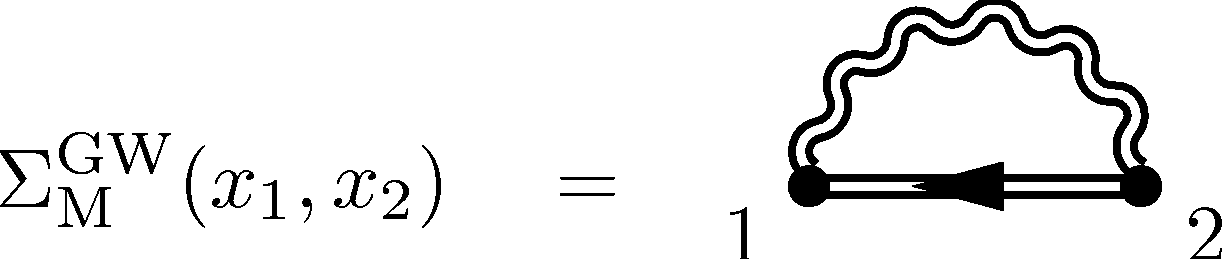
The first Ab Initio implementations of the GW approximations on simple bulk insulators
and semiconductors are due to M. Hybertsen and S.G. Louie, and
R.W. Godby, M. Schlüter and L.J. Sham.
They showed that a non-selfconsistent
G0LDA WRPA Self-Energy, can already reproduce,
within an error of 1%, the removal/addition energy observed in angle-resolved
photoemission experiments.
Since then, the validity of the GW approximation has been confirmed by many
other calculations. But some doubts have also been raised, since it seems that a fully
self-consistent GW Self-Energy does not improve with respect to the first iteration
Self-Energy, and it is even worse. Today the mainly accepted idea is that a fully
self-consistent Self-Energy requires also some Vertex corrections (tautology).
Many justifications of the validity of the first iteration
G0LDA WRPA approximation have been
offered so far, but none is completely satisfactory.
A short introduction to the GW Approximation can be found
here.
The authorship and the responsability of the informations hereby provided
belongs to Valerio Olevano.